

An international collaboration between Isabel Chillón, a researcher at the IGMM, and scientists from the Cima Institute at the University of Navarra, the Spanish National Cancer Research Center (CNIO), and the Spanish National Center for Biotechnology (CNB-CSIC) has led to the discovery of the molecular mechanism of CONCR, a long non-coding RNA essential for cell division.
For years, proteins have taken center stage in biology because they execute most cellular functions. More recently, however, new players have emerged: long non-coding RNAs, RNA molecules that do not encode proteins but still take part in processes essential for cell survival. These molecules appear to play a particularly important role in cancer.
The discovery of these RNAs has highlighted a major gap in our knowledge. As the authors explain, we understand “reasonably well” how proteins perform their functions in cells, but we still do not fully understand how long non-coding RNAs carry out theirs.
This collaboration has identified the mechanisms of CONCR, an RNA molecule essential for cell division. These findings, published in the journal Molecular Cell, will advance the development of targeted cancer therapies.
“Understanding how long non-coding RNAs, or lncRNAs, work is one of the major challenges in molecular biology today, and could open up new avenues for the development of targeted therapies against diseases such as cancer,” says Óscar Llorca, Director of the Structural Biology Program at the Spanish National Cancer Research Center (CNIO).
The DNA that was never ‘junk’
For many years, scientists thought DNA’s main function was to store instructions for making proteins. However, human genome sequencing projects revealed in the early 2000s that less than 2% of our DNA encodes proteins. Much of the remaining DNA produces RNA molecules that do not encode proteins.
Long non-coding RNAs belong to this category. Although only a fraction has been studied in depth, research shows they act as molecular regulators of a range of cellular processes and can interact with DNA, other RNAs, and proteins.
However, “despite their enormous importance, precisely how they work remains a mystery,” explains Maite Huarte, Director of the DNA and RNA Medicine Division at Cima University of Navarra and co-leader of the study.
RNA and resistance to cancer treatments
Researchers have established that numerous long non-coding RNAs are altered in cancer. Some promote tumor growth, cell proliferation, or metastasis; others, by contrast, act as tumor suppressors. Many are being investigated as potential biomarkers for cancer diagnosis and prognosis.
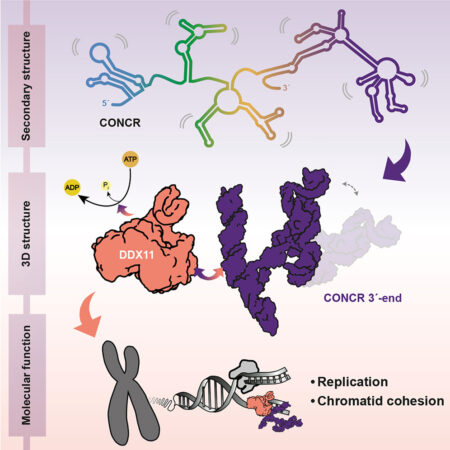
Research groups at IGMM, CNIO, CNB-CSIC, and CIMA focused on studying CONCR, a long noncoding RNA previously identified by Huarte’s group at CIMA. CONCR plays a major role in DNA replication and maintaining chromosome structure.
They work through a modular architecture.
The researchers discovered that CONCR works through its three-dimensional structure. As Fernando Moreno-Herrero, head of the Molecular Biophysics Group at CNB-CSIC, explains, “CONCR contains rigid regions with a defined three-dimensional shape that are connected by other, much more flexible regions of the RNA.”
The authors propose that this modular architecture, made up of distinct elements, underpins the function of all long non-coding RNAs.
“This concept could help decipher the function of many other lncRNAs. Specifically, we have been able to identify one of these structural modules as being responsible for the RNA’s activity through its binding to the DDX11 protein,” explains Isabel Chillón, researcher at IGMM.
The researchers also introduced mutations into the RNA that preserved its structure while altering its nucleotide sequence. This demonstrates that the RNA’s function is determined primarily by its structure rather than by its exact nucleotide composition.
The findings suggest that these long RNAs are organized into modules with specific structures that enable them to bind to proteins and regulate their functions.
Understanding RNA to design new therapies
“LncRNAs play crucial roles in regulating physiological and pathological processes and are emerging as promising diagnostic and therapeutic targets,” the authors state in Molecular Cell. “However, the molecular mechanisms that drive their cellular activities are still poorly understood, restricting the translation of lncRNA biology into clinical practice. Clarifying this issue will open the door to new therapeutic strategies,” the scientists conclude.
Read more : López-Perrote A, Martín-Cuevas EM, Mérida-Cerro JA, Aicart-Ramos C, González-Corpas A, González J, Le Coq J. Boskovic J, Chillón I*, Llorca O*, Moreno-Herrero F*, Huarte M*. CONCR lncRNA organizes a 3′-end structural domain that engages DDX11 for DNA replication and sister chromatid cohesion. Published online August 28, 2026. PMID: 42664968. DOI: https://doi.org/10.1016/j.molcel.2026.08.004
Source du texte : Services de vulgarisation scientifique du CIMA, du CNIO et du CNB-CSIC.